Friday, December 2, 2011

RASP - Improving our Soaring Forecast

Output of a typical RASP run.
Source: Valley Soaring.net
"Do you know what RASP is?"  It was a question from one of our best sailplane racing pilots.

I told him I didn't really know what it was.  It turns out to be a soaring prediction model called Regional Atmospheric Soaring Prediction, or RASP.   The RASP model turns out what are called blipmaps which are maps of soaring conditions that indicate all kinds of parameters of interest to soaring pilots.

These maps are already available online at www.drjack.com, but the grid areas are large and the terrain isn't considered as precisely as it could be.  Dr. Jack Glendening is an atmospheric scientist and the author of RASP.  He allows gliding clubs to use his code at no charge, but also with community-only support.

I took a look at RASP, which is a collection of Unix programs that are controlled from an overall RASP script.  It is a terminal only program - there is no GUI, and all output during the runs is written console-style to logs that you pore through to determine the source of your errors.  Parameters are in different directories and not always obvious.  The documentation for the program is fairly robust, but suffice it to say that troubleshooting a complex software package that you have never seen before is quite a challenge.

So far, I've managed to get RASP right up to the edge where it actually run the atmospheric forecasting program.  In effect, the program so far downloads the results of model runs from the National Weather Service, then preps them for a local run of WRF, the Weather Research and Forecasting model.  That's where the hard number crunching happens, then the results are output in a format you can put them on a website with graphical charts showing the results.

I've come quite a way to make just a little progress and I'm currently stumped at one error.  The forum for RASP is understandably small and Dr. Jack doesn't actively support RASP, so if I can't figure it out, I'm sunk.  I've got one or two ideas right now, but right now I'll give myself about a 70% chance of success.

Monday, November 28, 2011

Snowbird 2011 Contest

The 2011 Snowbird is now in the history books.  The longest running soaring contest is hosted annually at Harris Hill on the Friday and Saturday after Thanksgiving.


Open / Close
Hooking up and ready for takeoff  All photos courtesy of Stefan Trego: http://www.flickr.com/photos/stefantrego/

This was my second Snowbird, but the first one where anyone did any flying.  Last year's contest was weathered out with winds out of the West at 20 knots and gusting higher.  This year was completely different with reasonably calm winds and incredibly warm temperatures into the 60's.

I volunteered to log takeoffs and we kept two tow planes busy all day long with over 60 flights Saturday.  We had contestants from Finger Lakes and Valley Soaring and they brought their own 1-26 gliders -the machines of choice for spot landings.

Preparing to enter downwind for Snowbird.  All photos courtesy of Stefan Trego http://www.flickr.com/photos/stefantrego/
One of the nice things about Snowbird is that it is more a fun-fest than a contest.  With events like spot landing and specific duration, the point is to fly a short pattern and land at exactly the right time on exactly the right spot rather than be an ace pilot and stay aloft to fly fastest and furthest.

Spot Landings
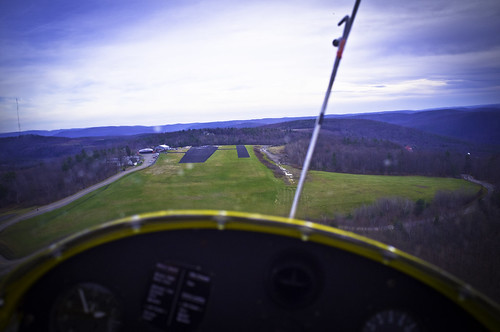
On approach during Snowbird.  The landing zone is on the right hand runway about 1/3 of the way up from the grass.  Can you see it?  I didn't think so.  All photos courtesy of Stefan Trego http://www.flickr.com/photos/stefantrego/
The event creates lots of...interesting approaches.  The landing zone is small, perhaps 40 feet.  If you touch down prior to the zone, you lose 400 points.  Overshoot it and lose 100, 200, or 300 points.  Then you have to stop pretty short and they measure your distance from a traffic cone.  The winner is usually decided by inches and seconds.  

Best landing of the day goes to two of our most experienced instructors -Dana Smith and Ron Ogden who touched down hot and laid down a good 180 feet of skid mark before crushing the traffic cone.  While they were a little sheepish, it's nice to know everyone is human.

I didn't fly this year.  I intended to hand over the log to someone around 1pm and fly a couple of flights, but pretty much everyone else was flying and there just wasn't anyone to do it until much later when I had obligations at home.  Even so, there was so much energy and activity on the flight line, it was still a lot of fun to participate.

Moving into the winter, we're going to be fairly active with rework on number 3 and buff and polish of the 4 ASK-21's we own.  I can't wait until April to fly again!

Tuesday, November 22, 2011

Photo Credit Dean Alexander.

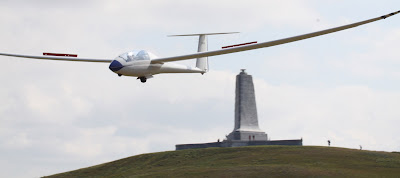
Harris Hill Soaring Corporation was asked to participate in an historic soaring event - Soaring 100 a celebration of the 100th anniversary of Orville Wright's nearly 10 minute unpowered soaring flight in Kitty Hawk, North Carolina.

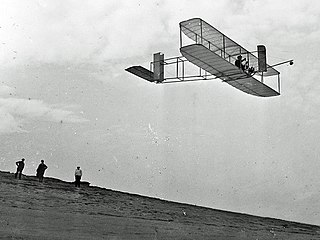
The Wrights successfully flew the first powered aircraft in 1903, but the first real, practical version of the aircraft was the Wright Flyer III in late 1905 back in Dayton on Huffman Prairie.  In 1911, the Wrights returned to Kitty Hawk with a glider to test improved stability controls and there on the dunes, Orville ridge soared for nearly 10 minutes in a 50 knot wind.  The record held for nearly 10 years before it was broken.

The 1911 glider soars over Kitty Hawk
Soaring 100 celebrated the achievement 100 years later and HHSC's membership made the trek to Kitty Hawk with a Duo Discus, a modern example of recent gliding technology.  Club member Mo Acee piloted the Discus in demos for the crowd, landing on the same stretch of grass that the Wrights flew the original Wright Flyer from.  Only 15 examples of gliders were selected for the demo flights and it was nice that HHSC and the National Soaring Museum were asked to participate!

Monday, October 31, 2011

Season's End Again

What an interesting soaring season I had!  I accomplished my goal of earning my commercial glider pilot's license and my son decided that soaring was a passionate interest for him.  Meanwhile, I developed a new motto to deal with the awful weather - "Never pass up a good flying day."

That held true even yesterday, the last day of scheduled ops for 2011 on Harris Hill.  I'd gone up there to meet with one of our club members to discuss some business but the weather looked so good I convinced my son to go with me.  "We'll only be a little while...,"  I told my wife.  I've been soaring long enough for her to see right through that lie.

It was quite cool, but when I said hello to some of the folks there it became quickly apparent that the conditions were really quite good for soaring.  After a few minutes of discussion, Kevin and I decided that it would be foolish to pass up conditions like these, especially since we probably won't fly regularly until April at best.

After deciding to fly the ASK-21, I put Kevin in front and off we went.  It took almost no time to get to altitude because Tim Welles, our tow pilot, knows how to tow through thermals and uses them to shorten the time on tow.  We got off at 2,000 above ground (3,700 on the altimeter) and were immediately in lift.

I'd turned over the flying duties to Kevin shortly after takeoff and he did a good job of keeping us in the lift as we climbed over the valley North of Harris Hill.  It looked like there was cloud streeting, so we decided to push out along the street to see if we could go anywhere.  In most cases, we saw zero sink and when we reached the South end of the street, we found 4 knots of lift that strengthened and turned into 6 knots!

Cloud streets are horizontal lines of clouds that are usually indicative of thermal activity
Kevin took us up close to the bottom of the nice, dark cumulus cloud and we topped out at 5,800 feet, a new record altitude for him.  We stayed up about 45 minutes and returned when we began to get cold.  I flew a passenger later at the end of the day and we did some stalls, a wingover, some zero-g pushovers and had a generally good time together. 

My landings in the ASK-21 are getting much more precise and I've been able to touchdown exactly where I wanted to and make those long slow rollouts balanced on the center wheels all the way up to the flight line.  Quite often, the juniors on the line will catch the wing before it touches the ground.

My goals this year were to get my commercial license and to do a better job of handling the ASK-21, especially on landing.  While I've felt competent in the 21, I now feel much more confident in it.  It's a good way to end the soaring season.

Monday, September 19, 2011

Flying the 2-33....again


I forgot how much I like the 2-33
After flying commercial flights for several hours, I was ready for a break but my son wanted to take a flight.  The ASK's were busy with passenger rides, so I saddled up in the back of the trusty Schweizer 2-33.  Kevin was thrilled to fly his training aircraft.  I did the takeoff, then turned it over to him for the tow and rest of the flight.  He flew a tad high on tow, but would generally correct back to the proper position and I could see that he's definitely 'getting it' and learning how to handle the aircraft.  A couple of bumps kept him alert and were good experience.  Pretty soon we were up to release altitude - 3700 feet above sea level.  We released and began looking for lift.

I directed us over the hang glider launch since that's where I'd found a pretty reliable thermal for most of the day and sure enough, we found it.  The thermals were a bit odd with shear in them and sort of an on/off feeling to them.  I'd been able to center them in the ASK-21 with passengers, but I thought I'd let Kevin try his hand at it without too much direction from me.

Pretty soon we were circling with good lift on one side and zero on the other.  The right thing to do is to try and move your circle towards the stronger side of the lift by banking steeply on the weak side and making a more shallow bank when you are on the strong side.  This moves your circle, hopefully strengthening the lift so you are in it all the way around the circle.  I gave a little direction to Kevin and pretty soon he had it centered and we started climbing steadily.  We topped out right at release altitude after 700 feet of climb or so and I could tell he was pretty excited that he made it happen.

We flew around a bit more, discussing what to look for and think about and then he set us into the pattern for downwind.  I took over from there and made the landing, talking through the checklist with him and explaining what I was doing and why.  As we turned base, I told him that I thought we looked a bit high and he agreed.  What he didn't know was that there was sink off the end of the runway but I did because I'd flown through it all morning.  With spoilers almost closed, I used it to bring us down and turned final only slightly high.

Kevin said, "You're too high," but since I barely had the spoilers cracked, I just eased them open, brought us into line, then eased them almost closed and touched down in the grass right where I'd been aiming.  After we got out, I smiled and said, "So you thought I was too high, eh?"  It was good to know I could still fly the 2-33!  

It had been a couple of months and I get nervous about being used to flying a higher performance glider, then flying a lower performance one -especially since I was in the back.  But it turned out to be the same trusty 2-33 I learned to fly in and it was great fun to fly it again.  Plus, we both enjoyed flying together and he seemed pleased to show me what he'd learned.  I know I got a kick out of it.

Return on Investment

Yesterday I worked my first full commercial pilot shift at Harris Hill.  I was scheduled last month but we were weathered out with a no-fly day.

Yesterday was different - a cool morning with river fog gave way to a sunny and spectacular Fall day at Harris Hill.  When I arrived, there were three passenger rides waiting and after a slight delay to allow the fog to burn off, I started giving rides.  Taking a glider ride was apparently a popular idea as we steadily built up a queue of people waiting for rides.  By the time I landed with the second passenger, we had three gliders in passenger operation and kept them all busy until 5pm.

I gave 8 rides that day and passed the magic number of 12 passenger rides which is the point that the personal cost of getting my commercial license is exceeded by the cost of flying 12 times.  So, now I'm on the plus side of the ledger and every flight I make with a paying passenger is gravy on top.

I like introducing people to soaring and although the weather was quite good, I really liked flying steadily for a period of 4 or 5 hours because I got to experience the changing conditions from smooth and calm to thermal activity.  The East-Southeast wind we had was very, very light on the surface but caused some turbulence and a decent crosswind on takeoff and landing.  It was quite different in the sky than on the ground and it was interesting to experience it evolving.

Even though it was a light wind, there was a good deal of sink on final approach, but I had anticipated it and making 8 landings gave me a good feel for what it looks like under those conditions.  The other thing that is nice is that you aren't trying to stay up for a long time.  Twenty minutes or so is the length of the ride, so if you find a single thermal you can easily make 20.  You stay near the field and simply fly wherever you want with no particular destination or task necessary.  You pass a few minutes of pleasant conversation with passengers and then return for landing.  Nice.  And of course, you get more experience with flying the ASK-21.

All in all, a great decision to get my commercial rating this year!

Saturday, August 6, 2011

Region 3 Glider Contest

Harris Hill just finished hosting the region3 glider contest and it was good fun.

The contest is a race - whoever flies the farthest the fastest scores the most points.  Each morning a specific course is laid out for the contestants and they must fly to various turn points on flights that can last 2 hours or more.  Distances are generally 100-200 miles.

There are two classes of aircraft FAI and Sport class and they compete in their own class.  The contest lasts a week, which is good since they had only 3 reasonably good flying days plus 1 practice day to get ready.

I worked the retrieve office for the contest.  Our job was to track who took off and place a prepared card on the window as they departed.  When they landed, we would take the card down.  It's a simple way of tracking who is back and who isn't.

If a pilot can't make it back and 'lands out', they are instructed to call the retrieve office and give us relevant information about their location and how to contact them.  We then flipped their card over to the red side as a signal to their crew that they need to get the trailer ready and go get the pilot and glider.

We had a couple of land outs but not really too many.  Contest pilots are usually quite seasoned but as they push themselves to complete a task, there's always the possibility of a land out.  Sailplanes are designed for this and pilots are used to it.  The old joke goes, "There are those pilots who have landed out and those that will."  Everyone gets a turn eventually, especially when trying to win a contest.

Our Harris Hill juniors did an outstanding job of volunteering and working the competition and everything went smoothly for the week.  Watching the pilots launch and waiting for them to return, I wondered whether I would ever do any contest flying.

I doubt it.  The learning curve is steep and to be any good at it you need to fly cross country an awful lot.  Also, the contests are a week long which puts a crimp in the vacation leave time, plus you have the expense of staying wherever the contest is and of course, you need to own a glider or have one you can take with you.  That's a lot of difficult variables for a married person with kids nearing college age and it explains why many of the racing pilots are retired.

Andy Brayer won the Sport Class
Interestingly, the Sport Class competition was won by our very own Andy Brayer in a borrowed Discus glider owned by Harris Hill!  I guess that sort of shatters the barriers, but of course those were taken care of  because he flew the glider from its home base and the contest was held here at Harris Hill.  Nevertheless, I'm really happy for Andy - he's one of our juniors and he's turned into a top notch pilot who selflessly give training to our juniors all summer long.  He obviously worked hard for this win and he earned it by winning every single day that we flew -particularly against Roy McMaster, one of our ace pilots with a great competition history under his belt.  Congrats to both Andy and Roy for their 1, 2 finish.