Sunday, July 22, 2012

XC - Cross Country

"What do you mean you haven't flown in the Duo?  You need to get in there!," one of our senior members said.  It was late in the day and the lift was still good, with cycling cumulus clouds for most of the afternoon.  The sun was starting to move lower in the sky but there was still some lift left in the day.

I explained that I'd been trying to arrange cross country instruction in the Duo for several weeks but a broken canopy latch had kept our Duo Discus grounded for a couple of weeks.  Just then, someone exclaimed, "Pretty!" and the very object of my desire -the Duo, flashed past in a high speed low pass, pulled gracefully up and entered the pattern for a landing.

After it rolled to a stop, the instructor yelled, "Anyone need the Duo before I put it away?" and the senior member I was talking to shouted back, "Tom's going to use it!"  He quickly arranged for one of our advanced instructors to take me for a ride.  "Go!  Go!," he shouted and before I knew it I was in the front seat of a competition class sailplane about to take my first cross country trip.

Monty Sullivan, the instructor, talked me through the basics of the takeoff, we hooked up, I waggled the rudder and we were airborne almost immediately.  The ship handles very nicely and wasn't skittish or difficult to fly.  I spent some time getting used to the feel as we climbed and pretty soon we were off in a thermal.

After that, it's all sort of a blur.  But a happy one.  I spent a little time feeling like I was mishandling the Duo and it took awhile to sort out the low and high speed characteristics but despite my clumsiness, we were circling through 5,200 feet in just a few minutes and set off to the south from cloud base.

The most impressive thing about the Duo is the speed range.  It handles well circling at 45 knots and is equally at home screaming through the sky at 80 knots.  The handling is light but not twitchy, the aircraft doesn't feel nearly as big as the specs say it is (20 meters) and it is an easy touch to fly.

I won't bore you with the blow by blow of the flight - it was simply a short out and back in the evening lift, but it was further than I'd ever flown from the Hill before and it was so much fun to do it with the confidence that an expert instructor brings with him.

Arriving back at Harris Hill, we milked the lift for all it was worth at 7:45pm and set up for landing in still air.  The approach speed is similar to the familiar ASK-21 although the glide ratio is better, so you need to keep that in mind as you approach.  Only upon touchdown did the mass and wing size of the Duo become apparent.  I was certain we were out of airspeed and the beast would give up flying just as we touched but no - a bump and we floated again for another 50 feet before we touched down for good.  It also took a lot of brake to bring us to a stop, even though we'd touched down right on the numbers.

To say I was excited would be an understatement.  I REALLY enjoyed breaking free from Harris Hill, even though we never went all that far - perhaps 15 miles or so.  But it was enough for me to get very interested in flying some more.  It's really another level to soaring and one I'm looking forward to exploring.

Tuesday, July 3, 2012

Leveling Up

Although I'm a bit frustrated by my lack of progress on either the towplane or cross-country side of soaring, I've taken steps to fix the cross-country issue starting next week and in the meantime, I've continued to fly as much as possible, particularly commercial flights.

Recently, I was scheduled as commercial pilot on a day with awesome weather but a forecast for building winds.  By the time I began to fly, it was 15 knots steady with about a 20 degree crosswind with gusts above 20 knots.

Before flying passengers, I took the time to talk to an instructor, asked several pilots who were flying, and talked to the previous commercial pilot about the conditions.  They were as I had expected - yes, the winds were strong but the crosswind component wasn't enormous and the required North landing was the area of interest.

On a day when you have strong winds from the North, you approach the runway from the South, heading North.  Because that is on the lee side of the ridge, you can expect any or all of the following:  turbulence, wind shear, rotor, sudden loss of airspeed.  Flying myself is one set of risk management decisions.  Flying a paying passenger is another set.

Based on my consultations and experience level, I decided to take a passenger flight.  Knowing that the winds would strengthen as the day went on, I kept that in the forefront of my mind for whether I would take another passenger later.  My plan was to be particularly alert for uncontrolled departure from intended flight path on takeoff, releasing if necessary.  On landing, I would stay very close to the field, add 10 knots to my approach speed to compensate for shear, expect turbulence and turn final early to prevent an overshoot.

My passenger was a 3,000 hour helicopter pilot.  I made sure he knew that it could be bumpy but after we got a few hundred feet below us that it would smooth out -at least until we landed.  He said he was looking forward to it.

Takeoff was smooth and uneventful.  I kept my hand near the release knob, made sure to correct any drift IMMEDIATELY and we rolled nice and straight until we were airborne and I crabbed into the wind after liftoff.  Whoosh!  We rode the elevator of lift up the front side of the ridge and had 300 feet beneath us in almost no time.  The tow was mostly uneventful until we got around the lee side of the ridge and I watched the tow plane sink waaay down below me.  I added opposite rudder for more drag and eased the nose down just as the tow plane popped up again giving me a slack line.  I kept the rudder in and let it out just as the rope went taught.  Problem solved and we were back on tow in the proper position.

I released above the ridge in the company of at least 4 other gliders and the flight was excellent.  Real ridge soaring in consistent winds, smooth and positive lift.  Either end of the ridge worked best and we spent most of the 20 minutes over the ridge flying slow, fast, circling and generally playing around.  We  started our descent from about 500 feet above where we'd released originally.

I entered the pattern midfield and set my approach speed to about 63.  In a flash we were downwind.  Given the tailwind and my extra speed, we were probably traveling close to 80 knots over the ground.  I turned to base early to keep from over-running it, then flew the base with the requisite crab as we began to pick up some turbulence from the hill that lies on final to the runway.  I turned early to final so I wouldn't overshoot and rolled out with plenty of altitude.  I extended spoilers fully, pointed the nose down to keep the speed up and we flew off the altitude without an issue.  We hit the normal shear and rotor on extremely short final, using up the last of our altitude and I settled in to the flare, touching down just slightly beyond my aim point.  I flew a couple of more rides that day, each one slightly windier than the last and we decided to cut passenger operations off for the day around 2pm.  

The most amazing thing to me was how confident I was in handling the aircraft in very windy and gusty conditions.  I know what my personal limits are and what they are for passengers.  The conditions were well within my no-go criteria.  Last year, I probably wouldn't have flown in these conditions but this year it was truly a non-event.  Effectively, I have 'leveled up,' in video game-speak.

I'm fully aware that with a few hundred flights under my belt, I'm still a less experienced pilot than many on our field.  I will do my best to balance the desire to push my limits outward and the over-confidence that can accrue to a pilot with moderate experience.  They say that in the power flying world there is nothing so dangerous as a 200 hour pilot.  That's the level where you think you can handle anything but you haven't seen it all yet.  That is probably where I am right now.  I'm eager to take on more challenging flying but have to balance that against the macho pilot instinct to fly regardless of conditions.  Especially with passengers, who expect ME to keep them safe.

I did an accurate assessment of my experience, the risk of flight, and the expected conditions, but the flying was not what puts me up a level.  It was my decision to quit flying as the winds developed further.  The difference between 13 gusting to 25 and 18 gusting to 35 is one mainly of degree and risk.  While I could have flown a personal flight in the latter conditions I didn't do it with a passenger.

THAT'S my level up. 

Saturday, June 23, 2012

Epic Soaring

The soaring today couldn't have been better!  

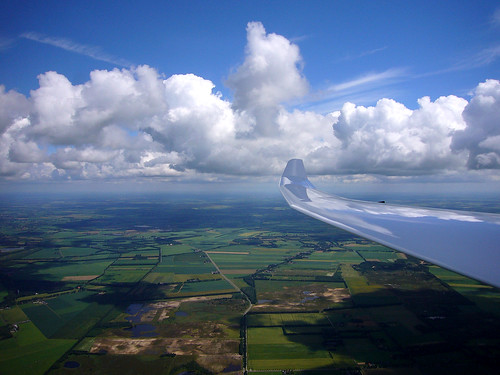
Good soaring today.  It looked a lot like this picture.
I showed up at Harris Hill later in the afternoon, a crisp, clear, 80 degree day that makes the summers in  the Finger Lakes so very, very pleasant.  I had, ahem, domestic duties to attend to but I kept glancing at the building cumulus clouds and feeling the day slip away from me.

Finally, around 3pm I made it out there and they were looking for someone to give a passenger ride so  I strapped in and took Amy from Big Flats up for a ride.  The conditions were GREAT and we stayed up almost at will, enjoying the scenery below.  At least 5 other gliders were near us -some high, some lower, some at our altitude.

After landing, there were no other passengers to take up but the conditions were so good, I decided to go alone.  I took off and Roy McMaster, our tow pilot, towed me right into a huge thermal.  I should have let off right then but was a little slow.  Fortunately, Roy did a 180 and towed me right back into the thermal.  I cut loose and started my climb upward.

4,000, 5,000, 6,000 feet and the thermals were solid with 4-6 knots showing on the variometer.  I looked out and saw a cloud street headed toward me, so I circled and waited.  Pretty soon, I was near cloud base and sharing the thermal with a hang glider.  As I topped out, I decided to jump across the blue gap over to the cloud street.  I pushed 70 knots through the blue and pretty soon I was across and under the next street over.  

The lift was good, the street was long, and I followed it down South of Elmira over Southport.  I was losing almost no altitude during the transit and used the time to figure out where the best lift was.  I turned back and traversed the street back to the North.

I spent the rest of the flight jumping from one cloud to another and trying to work on how to use them to move from one part of the sky to another.  After some time, I centered up a NICE 6 knot thermal underneath a cloud and rode it up to cloud base.  I began to get some rain on the canopy and checked to be sure it wasn't turning into a thunderstorm.  Off in the distance, I'd been watching a buildup that was moving towards me and decided that although the conditions were good, they were dying just a bit and I should probably get down and get the glider put away.

I landed around 5:30 with about an hour and a half on the clock.  The soaring was fantastic, and the skill building was great practice for cross country flying.  All in all, one of those soaring days that you dream about in the middle of winter and hope for on a summer weekend.  Awesome.

Thursday, June 21, 2012

Dreaming of cutting the strings...

I have...had...two goals for my flying this summer.  First, I wanted to get my tailwheel transition signoff  so I could learn how to fly as a tow pilot for our operation.  We're quite shy on tow pilots and...well...there's no reason I can't operate an aircraft with an engine.  I am, after all, certified for Aircraft Single Engine, Land (ASEL).  It's just been a while.  Plus, I sort of have a distrust of aircraft with engines, now that I've been flying aircraft without them for quite some time!

Anyhow, that goal is on hold after an incident that caused our club's Super Cub to depart the runway in gusty conditions (I was not part of this incident) and end up with quite a bit of damage.  It's out of commission for quite some time, likely the balance of our flying season at the very least.

The object of my desire - the Schempp-Hirth Discus
On to my second goal - get certified in the single seat Discus and learn to fly cross country.

They call it 'cutting the apron strings' and it means flying out of gliding distance from your home airport and often from any airport.  It is something that I've been trying to prepare for since I got my glider rating.

First step - fly with one of our cross country instructors in the Duo Discus, a two seat version of the Discus.  We are so fortunate to have world class pilots who will instruct you in the technique of cross country flying at Harris Hill and I will take advantage of that.  Once I learn the basic techniques, I'll get a checkout in the single seat Discus and the fly in tandem with another cross country pilot -me in the Discus, him in his glider.  I'll follow him to see how he does it and hopefully learn enough to begin learning on my own.

I also have the Condor glider simulator to work with.  It's a great tool for learning how to cross country soar.  I've ordered rudder pedals for my computer setup and will start giving it a workout.

I am, as everyone is when they start pushing out beyond the airport, excited and nervous.  I've done two things to try and prepare for this phase of my flying.  First, I've worked and worked at flying thermal circles at a steady airspeed and at least 45 degree bank angle.  It is critical to know how to quickly center and take advantage of a thermal when you encounter it.  I'm better than I was and I think I'm good enough to go out with an instructor and fly cross country.

Second, I've been learning about spotting lift conditions and cross country considerations.  I've read Helmut Reichman's excellent book, "Cross Country Soaring" on the advice of instructors and there is a LOT of information in there that can help you stay aloft.  I need to re-read it as I begin to fly cross country.

It's going to be a little while before I can get started, though.  Right now, my real-life workload just won't let up and has conspired to keep me from being flexible enough to pick a day to take off for training, a prime requirement for a good training start.  Hopefully, that will let up a bit soon but I've been thinking that for the past month and it hasn't happened.

It's killing me, too.  One of my soaring friends recently cut the strings and flew away on his first 150 mile triangle and sent back incredible pictures of him with a huge grin on his face as he circled at cloudbase.  We both started flying around the same time and our flight 'careers' have progressed at roughly the same pace.  I was surprised how much those pictures made me realize that I have to get REAL about making my transition to this new level of flying.  I'm not sure it is what I'll do ALL the time, but it is something that will make me a much better pilot, whether I fly locally or not.

Anyhow, I'm looking forward to the trip and I'll keep posting here about the journey.

Saturday, June 9, 2012

That Voice in Your Head

Sometimes a little bit of experience can go an awfully long way and I'm finally getting to the point that *I* have some experience in soaring rather than taking it in from others.

Today wasn't the *best* day to fly passengers - when I got to Harris Hill it had just rained, but was clearing nicely.  There was a high overcast but we had a window of decent weather before winds were expected to build a bit and rain would return later in the day.

I was the commercial pilot on duty and right away we got a passenger.  As I said, the rain was a short shower and the ceiling was quite high, still overcast, and the radar showed showers NE and SW of us, but not coming our direction.  I took the passenger up, we had a great flight and when I got back, we waited for more passengers.  It was a slow day.

In the meantime, Tim Welles, our CFI was busy taking students up for training.  As the morning wore on, the winds began to build and by twelve-thirty I saw a few gusts to 15 mph.  But the wind was a mild crosswind, perhaps 30-45 degrees and the ridge began to work.  Our students were still flying and I kept my eye on the radar.

Around 1pm, we got another customer.  I explained to her that the winds might make it a little bumpy but the ridge would be working and we should have a good flight.  Sure enough, we had 1,000 feet before we cleared the hang glider launch point.  Near the top of the tow I got a few droplets of water on the canopy.

That's when I knew I'd been here before.  My only landout in our emergency field happened in the same conditions minus the wind.  I'd been looking at the weather but looked closer this time to see if any rain looked like it was on its way.  MAYBE there was some out to the North/Northwest but it was hard to tell.

I flew along the ridge and watched the glider below me, two of our members who were riding the ridge in an ASK-21.  I wanted to see if they turned into the pattern to land.  If they did, I'd probably do the same thing.

We stayed up for a few minutes and then I spotted what looked like heavier rain coming towards us, perhaps 10 minutes off and I began to pick up sprinkles of rain on the canopy.  I decided to land before the gust front hit, so I opened the spoilers, descended into the pattern and put it on the ground.  My passenger had a great flight despite the rain and in truth, we were probably only shortened by 5 minutes or so.  

A few minutes later, after the other glider landed, we felt the gust front come through and I was glad I'd made my decision to land.  It was that experience from my previous landout that allowed me to recognize what was likely on its way.  It's funny to think that when I started this blog, I was a newbie pilot and now I'm writing down today's flights as my 218th in a glider.  That's not a LOT of experience, but it is adding up to the point that I'm able to use it in my decision making.

Friday, May 25, 2012

Emergency Procedures

"We're not climbing properly," I said to my passenger as we took off from Harris Hill on a beautiful Spring evening during one of our weekly training sessions.

Seconds before, I had been sitting on the runway awaiting my turn in the tow line while running through the checklist.  I asked my passenger (a friend of my son's) to read each of the steps while I performed the check.  When we got to the Situational Awareness line, I explained that now is the time to visualize what you would do if something unexpected happened.

Usually, that's a tow rope break but a few moments later I was dealing with a potential towplane engine problem.

The initial tow up to takeoff speed was SLIGHTLY different but not enough to alarm me.  It felt like slow, smooth acceleration but as we rolled down the runway I noticed it took a bit more distance than usual to get airborne and that we weren't accelerating quite as fast as normal.  I glanced at the airspeed indicator as I lifted off and it was about 5 knots slower than it should be.

I watched the towplane, still rolling on the runway, pass off of the pavement and onto the grass, bounce once hesitate in the air, then bounce again on the grass and finally stay in the air.  As we passed over the brow of the hill, it followed the contour down to gain speed.  We were at 60 knots, the proper tow speed for the ASK-21 glider it was towing.

Harris Hill is atop a ridge some 700 feet above the valley and within a few seconds we were blessed with 700 feet of altitude to sort things out.  I followed the tow plane, climbing VERY weakly, but at least climbing, as we turned to the West.  I made the remark about the tow plane not climbing properly and prepared to release if I saw the propeller stop.  We continued West, alternating between a weak climb and maintaining altitude.

I keyed the mike and asked the towplane pilot if everything was okay.  No response.  I located the emergency...er, ALTERNATE, landing field in the valley below and prepared to land there for the second time in my gliding career.  As I did, the tow plane made a 180 degree turn and we headed back toward Harris Hill at what looked like the same altitude as the runway.

We arrived on what I would describe as a very close right base leg and the tow plane rocked its wings from side to side -the signal to a glider pilot to GET OFF.  I released immediately but didn't think I had the altitude to get back to the runway.  "We're probably going to have to land in the valley below," I told my passenger.

I continued gliding towards Harris Hill and made the decision that I would only try for the field if I was sure I could make the turn - a 90 degree right hander without getting close to the ground.  After all, on my left was the safety of the valley and the field below.  The last thing I wanted to do was try to be a hero and dig in a wingtip trying to turn too low.

I lost little altitude as I flew down base, but I was MUCH lower than I usually am.  I took one more look and decided that not only did I have enough to make the turn safely, but that I might actually have a shot at not landing in the grass short of the pavement.  I checked my airspeed (speed is life!) and decided to make a gradual turn with the idea of landing diagonally across the field if I misjudged my altitude or encountered sink.  The grass landing would be uphill and there would be no danger of overrun if I had to roll out and land before completing the turn.

I lined up on final, spoilers still closed, and flew a normal approach at the normal speed, easily making the paved threshold of the runway, touching down with spoilers closed.  I immediately popped them open and maneuvered us to the edge of the runway to get out of the way of the tow plane who, I was sure, would be right behind us.

He arrived a few moments later and we discussed what happened.  "I left the carb heat on somehow."  Carburetor heat keeps ice from forming in the venturi and choking off air to the engine.  It is usually used on landing and apparently the tow pilot forgot to turn it off.  When it is on, it robs the engine of about 200 rpm of power -apparently just enough to make climbing out with a glider attached quite difficult.

Later that evening, I reflected on what happened.  I felt good about the fact that I was never particularly alarmed, I kept my cool and made good decisions.  My training for rope tow breaks took over right away and everything worked out just fine.  It really helped that Harris Hill is on a ridge.  If we'd had to clear an obstacle on flat land, the ride would have been much hairier.  As it was, I gained more experience and learned a little something about my flying skills.

Monday, May 14, 2012

Taking Another Step in my Soaring Journey

"Can I speak to you for a minute?"  It was Peter Smith, the Director of the National Soaring Museum and a good soaring friend.

Turns out the topic was rather interesting.  The National Soaring Museum is operated separately from Harris Hill Soaring Corporation but the two are intertwined in terms of interests.  Harris Hill Soaring has members on the board of the NSM and NSM has a position on the Harris Hill board.

The opportunity was to become a board member of the National Soaring Museum.  I was flattered and not sure exactly what the duties were.  While I am a board member at Harris Hill, I don't know the day to day challenges at the NSM.  I hesitated, then began to ask a few questions.  I told Peter I would get back to him.

Later, as I thought it through, I decided I'd accept.  I'd been toying with the idea of not running for the board at Harris Hill this Fall because I'm already the webmaster and the duty scheduler PLUS I've been running the experimental forecast product, RASP for this summer.  It's quite a bit of effort and I thought I'd take a break for a short while.

This seems like an opportunity to help out in a different way.  Hopefully I'll find a way to fit in and contribute.  It's another step in my soaring journey.