Tuesday, September 4, 2012

Cross Country Training Part 4

"Forecast: Crappy!," said one of the pilots at the field as Tim Welles and I prepared the Duo Discus for flight.  In my fourth cross country lesson, I learned quite a bit, including the fact that a forecast is just that - only a forecast.


As the image of our track above, shows, it was indeed possible to fly cross country on this particular day.  The yellow, orange, and red areas show the climb portions with yellow the weakest and red the strongest.  Dark blue shows heavy sink.  The departure point is at the top in the red "F" balloon and you can see that we headed South/Southeast from Harris Hill in Elmira down to SkyHaven airport just to the West of Scranton, Pa.  Total out/back was approximately 155 miles and took 3 hours, 15 minutes.

This time, I tried to be more proactive in flight.  I called out audibly, "I'm looking at the cloud street over there and think that there may be lift under it and if not, there is another set of clouds that look like they will work."  Tim is a world-class competition glider pilot and I made sure to distinguish between what I thought my level of confidence and experience would be vs. what I would do with him onboard.

Tim threw everything at me this time.  I really like his method of instruction - he's both complimentary and demanding.  Rather than make you feel stupid, he tells you when you do something well ("you are entering and centering the thermals better") and balances that with teaching lessons ("what did you turn that direction for?!")

I experienced task overload, just like he said I would - try editing the turnpoints on the PDA while keeping the thermal centered plus deciding which direction you will be going when you reach the top of climb!  As Tim said, a lot of the things I should be doing weren't things that were unknown to me, but it was the context of the flight that makes them sometimes lag behind where I should have been completing them.

The actual flight went pretty well - our departure from Harris Hill and trip to the Southeast was 180 degrees opposite from where we *thought* we would fly before we put the glider together.  The forecast didn't really accurately depict the possibility of overdevelopment to the Northwest as much as it actually occurred.  We headed Southeast instead and as we flew along the bases went higher and we found decent thermals in 6-8 knot range that allowed us to average 5 knots in climb in many cases.

We did have to jump across the blue hole drifting South from Seneca lake and that hole persisted all the way South along our route, requiring us to cross it on the way to Towanda and then cross it on the way back to Mansfield.  This was the trickiest part of the route as cloud streets gave way to more sparse and less developing clouds.  The route I picked might have worked, but Tim vetoed it and we headed more Westerly.  He flew for pretty much the only time the whole trip.

That was when I got sick.  I thought I'd been doing pretty good, but for whatever reason, I did.  Fortunately it was minor and after managing to use the bag, I took over again and flew the rest of the way without issue.  Sigh.  It is what it is.  I've always been a tad prone to motion sickness but my tolerance since I learned to soar has gone up significantly.  I'd say that after 2-1/2 hours of flight with plenty of circling and warm temps, I did reasonably well to last as long as I did.  Whatever.  The real cure is to simply fly some more, so I'll keep doing that and have a bag handy if necessary.

After that little episode, I felt better but I need to figure out how to make the seat more comfortable.  You practically recline in the Duo but since we're not flying contests in it, we don't wear a parachute, which acts as a cushion.  I used a couple of pillows we have laying around but I need to pay closer attention to what I'm using.  My back was sore the next day!

As we approached Mansfield, Tim wanted to point out the local landmarks and it was amazing that you could see all the way to Cowanesque reservoir, our turnpoint and looking Northeast, Harris Hill.  It had been a bit hazy most of the way but the conditions were changing and the haze cleared.  I took a boomer of a thermal near Mansfield and after topping out at 7,000 feet felt I had plenty of altitude to get home, which was helped by the fact that there was still quite a bit of lift in the blue!  We showed in excess of 10 knots of lift even flying in a straight line and took full advantage of it.  On final glide, the computer reported I would have at least 2,000 feet above field elevation so I put the nose down and we rocketed the last 18 miles or so at speeds sometimes in excess of 100kts (about 120 mph).  It was glorious.

This time, I managed to slow us down, get us configured, and enter the pattern at the proper airspeed.  It was still a struggle to suddenly fly so slowly after zooming into the area but I kept a close eye on it and flew the pattern to Tim's satisfaction.  Touchdown was sooner, speed was slower, and we coasted to a stop almost precisely on the location we'd left some three hours prior.

What's left?  Tim is on duty next Saturday.  Weather permitting, I'll get a checkout in the single seat Discus, our club's competition level sailplane.  I'll fly locally and find out how it handles (everyone says it flies like a sports car), and hopefully make a couple of landings with it.

Then, I'll do a lead-follow.  One of our experienced instructors will lead and I'll follow him on a cross country flight.  We'll keep in touch on the radio and I'll get to fly it on my own skills alone.  After one or two of those.....well...I'll be on my own!  A whole new dimension of soaring will open up for me and one that I hope I'll be able to become good at.  I'm looking forward to it.


Friday, August 31, 2012

Cross Country Training, Part 3

The day started with little promise as I arrived at Harris Hill to a lead gray overcast.

"You know, we're probably not going anywhere today", my instructor, Tim Welles, said. I acknowledged that, but I asked him if we could at least check me out in the club's Discus so the day wouldn't be a total loss.

He agreed and within the hour were strapping in to the Duo Discus for local flight training. We stated up about twenty minutes but the building Cumulus clouds signaled that if the overcast would clear, the day still might take off.

A few minutes later, we were climbing in a thermal and in no time at all, Hariis Hill was receding into the background. We were headed cross country.

Cloud bases were just 4,500 feet giving us a scant 2,500 feet above the high ground, but we stopped early and often for more lift. As we headed West, the bases rose but so did the floor and we eked our way into the lift, managing to stay aloft.

It took us over an hour to fly the first 50 miles.  Some clouds would work, others wouldn't.  We wove under all of the scraps of clouds but it was in the blue that the thermals were best.  Finally we arrived over Hornell, and turned back for Harris Hill.  We kept especially alert to stay in the upper third of the altitude band, especially over the higher ground.  The turnpoint at Hornell was Arkport airport and I was sort of hoping for some lift to take us higher as we turned.  "If you hang out near an airport in case you land while looking for lift, you'll usually end up landing there," Tim laughed, as I circled vainly working weak lift.  We pushed out and towards the town of Hornell.

"I've got it," Tim said as we sunk below 4,000 feet.  The town was looking kind of close, below.  Under a likely looking cloud, he circled, adjusted, circled, adjusted, circled, decided that the weak lift was the best we would get and kept circling.  Slowly.....slowly....slowly...we gained altitude.  After what felt like about 10 minutes, I began to consider exactly when I would begin to feel sick and how long after that it would take before I threw up.  Fortunately, the answer was never!  On this day, I'd felt much better than the previous flight and while I'm sure I could have reached my limit if we'd kept circling, it never happened.

"Okay, your aircraft," Tim said, as the lift improved and we climbed safely out of trouble.  I took over and kept us centered until we couldn't climb any higher and off we headed back to the east towards Harris Hill.

The lift was getting weaker and farther between as we returned.  A circle in promising lift would turn out to be a lie, we'd continue on and the same thing would happen a few miles later.  We were able to dodge from cloud to cloud in zero or weak lift but that would be erased by heavy sink.  Still, we were able to fly quite long distances without losing lots of altitude.  Eventually, I could see the town of Corning coming into view but it was clear we would need to gain altitude to get all the way back to Harris Hill.

We were within gliding distance of the Corning Painted Post airport when Tim called out, "Okay, my plane."  At this point we had perhaps 1200 feet between us and the high ground.  Weak lift under a cloud kept us from descending but climbing was a different matter.  Tim worked every inch of the lift area looking for the best spots but we weren't climbing.  Still, this was our best option.

More circling and a hundred feet of altitude gain was followed by...more circling and another 100 feet.  The computer said we needed 900 more feet to arrive at Harris Hill's runway elevation.  In another minute we had 200 feet more, then 300, then 400.  "Your plane," Tim said.  The thermal strengthened into a beautifully strong and easy to center updraft that carried us to more than enough altitude to make it back.  It took another couple of turns so we could speed up on the way back.

I left the thermal at 80kts and found plenty of lift on the way back.  So, I accelerated to 90kts.  It was exhilarating to burn along at 110+mph and it only took minutes to return to Harris Hill.

Perhaps I was a bit too excited because I entered the pattern hot and never got slowed down properly.  We put the gear down and I still flew into final with about 10kts of extra speed and a slight tailwind.  The Duo Discus is a marvelous machine and it does NOT want to quit flying, whether you want it to or not.  I landed long and had to get on the brakes hard to get us stopped before we went off the end of the runway.  "That was scary," Tim said.

Lesson learned.  Keep a razor sharp eye on the airspeed and keep it under control on landing.  If not, you'll be sorry.

Tim said the conditions during our flight were difficult.  I, being a cross country newbie, wouldn't know any different of course.  But it certainly took us quite a bit of time to travel only a little way - 132 miles total took us nearly 3 hours.  I was glad I experienced a difficult day and I learned an awful lot about proper thermal technique, what to look for, how to think two steps ahead and so forth.  What I really learned was that I can't wait to do it again.

Maybe this Saturday...the forecast is looking pretty good.

Friday, August 3, 2012

Cross Country Lesson #2

I got started in earnest on my cross country training today.

About two weeks ago, I got a taste of another dimension to the sport of soaring when I got my chance to fly the club's Duo Discus on a short cross country of an hour or so. Today was my first real experience in how to cut the apron strings and move out beyond gliding range of Harris Hill. It was both fascinating and frustrating.

Mostly fascinating. I learned a huge amount during our 140 mile flight. Stuff that would take years to learn on your own was offered up for free as the trip unfolded. I learned that I've more or less been eyeing the clouds up properly, that my instincts are mostly correct, and that I'm on the right track. Mostly.

It was frustrating because I felt I didn't fly as well as I could. I felt like I was mishandling the airplane, flying behind it a bit. I don't think I flew it nearly as well as I did the previous time.

I'll attribute some of it to not feeling lquite 100% today. I woke up feeling ever so slightly off kilter and after breakfast I felt mildly nauseous. But I attributed that to nervous excitement. It was...something else and i'm not sure what. At one point during the flight I felt ill and had to get some air. I didn't get sick, but I wasn't far from it. My instructor had me fly and the feeling passed, but I just wasn't quite right all day.

At least that's the excuse I'm going with.

Regardless, the whole experience was a blast! I got to fly in imperfect conditions, so it wasn't a Textbook soaring day. We headed West towards Hornell even though the forecast was for better conditions to the East. But the clouds were closer together that direction making it look less promising.

As we flew out over Corning, the thermals were cooking and it didn't take long to say so long to Harris Hill. We dodged from cloud to cloud and took a thermal or two that was promising. The issue was that we were never all that high. The thermals would weaken about 1,000 feet from the clouds and we were consistently around 4,000 feet the whole time.

At one point, we were down to 3300 and we needed a thermal. We sauntered around a bit, trying this spot, then another until finally we connected with a decent thermal and got back up to a more comfortable altitude.

We turned back East about 5 miles from Hornell and made it back quicker due to a tailwind. We zipped over Harris Hill after catching a monster thermal and riding it up near cloud base. We worked our way towards Binghamton without having to circle much. One glide segment was 42 miles!

The return trip was similar with two stops for altitude and a nice swoop over Harris Hill as we arrived home for landing. Total distance was approximately 145 miles at an average speed of around 59 mph.

I learned a lot about the art/science of deciding what thermals to use and what thermals to pass up. I learned about staying in the green zone of lift and how falling out can burn precious time. And I learned that you really can fly away from the Hill if you have the proper training.

I'm ready for more. I'm going to try to get checked out on XC this year, but as long as I'm making progress, I'll be happy.

Sunday, July 22, 2012

XC - Cross Country

"What do you mean you haven't flown in the Duo?  You need to get in there!," one of our senior members said.  It was late in the day and the lift was still good, with cycling cumulus clouds for most of the afternoon.  The sun was starting to move lower in the sky but there was still some lift left in the day.

I explained that I'd been trying to arrange cross country instruction in the Duo for several weeks but a broken canopy latch had kept our Duo Discus grounded for a couple of weeks.  Just then, someone exclaimed, "Pretty!" and the very object of my desire -the Duo, flashed past in a high speed low pass, pulled gracefully up and entered the pattern for a landing.

After it rolled to a stop, the instructor yelled, "Anyone need the Duo before I put it away?" and the senior member I was talking to shouted back, "Tom's going to use it!"  He quickly arranged for one of our advanced instructors to take me for a ride.  "Go!  Go!," he shouted and before I knew it I was in the front seat of a competition class sailplane about to take my first cross country trip.

Monty Sullivan, the instructor, talked me through the basics of the takeoff, we hooked up, I waggled the rudder and we were airborne almost immediately.  The ship handles very nicely and wasn't skittish or difficult to fly.  I spent some time getting used to the feel as we climbed and pretty soon we were off in a thermal.

After that, it's all sort of a blur.  But a happy one.  I spent a little time feeling like I was mishandling the Duo and it took awhile to sort out the low and high speed characteristics but despite my clumsiness, we were circling through 5,200 feet in just a few minutes and set off to the south from cloud base.

The most impressive thing about the Duo is the speed range.  It handles well circling at 45 knots and is equally at home screaming through the sky at 80 knots.  The handling is light but not twitchy, the aircraft doesn't feel nearly as big as the specs say it is (20 meters) and it is an easy touch to fly.

I won't bore you with the blow by blow of the flight - it was simply a short out and back in the evening lift, but it was further than I'd ever flown from the Hill before and it was so much fun to do it with the confidence that an expert instructor brings with him.

Arriving back at Harris Hill, we milked the lift for all it was worth at 7:45pm and set up for landing in still air.  The approach speed is similar to the familiar ASK-21 although the glide ratio is better, so you need to keep that in mind as you approach.  Only upon touchdown did the mass and wing size of the Duo become apparent.  I was certain we were out of airspeed and the beast would give up flying just as we touched but no - a bump and we floated again for another 50 feet before we touched down for good.  It also took a lot of brake to bring us to a stop, even though we'd touched down right on the numbers.

To say I was excited would be an understatement.  I REALLY enjoyed breaking free from Harris Hill, even though we never went all that far - perhaps 15 miles or so.  But it was enough for me to get very interested in flying some more.  It's really another level to soaring and one I'm looking forward to exploring.

Tuesday, July 3, 2012

Leveling Up

Although I'm a bit frustrated by my lack of progress on either the towplane or cross-country side of soaring, I've taken steps to fix the cross-country issue starting next week and in the meantime, I've continued to fly as much as possible, particularly commercial flights.

Recently, I was scheduled as commercial pilot on a day with awesome weather but a forecast for building winds.  By the time I began to fly, it was 15 knots steady with about a 20 degree crosswind with gusts above 20 knots.

Before flying passengers, I took the time to talk to an instructor, asked several pilots who were flying, and talked to the previous commercial pilot about the conditions.  They were as I had expected - yes, the winds were strong but the crosswind component wasn't enormous and the required North landing was the area of interest.

On a day when you have strong winds from the North, you approach the runway from the South, heading North.  Because that is on the lee side of the ridge, you can expect any or all of the following:  turbulence, wind shear, rotor, sudden loss of airspeed.  Flying myself is one set of risk management decisions.  Flying a paying passenger is another set.

Based on my consultations and experience level, I decided to take a passenger flight.  Knowing that the winds would strengthen as the day went on, I kept that in the forefront of my mind for whether I would take another passenger later.  My plan was to be particularly alert for uncontrolled departure from intended flight path on takeoff, releasing if necessary.  On landing, I would stay very close to the field, add 10 knots to my approach speed to compensate for shear, expect turbulence and turn final early to prevent an overshoot.

My passenger was a 3,000 hour helicopter pilot.  I made sure he knew that it could be bumpy but after we got a few hundred feet below us that it would smooth out -at least until we landed.  He said he was looking forward to it.

Takeoff was smooth and uneventful.  I kept my hand near the release knob, made sure to correct any drift IMMEDIATELY and we rolled nice and straight until we were airborne and I crabbed into the wind after liftoff.  Whoosh!  We rode the elevator of lift up the front side of the ridge and had 300 feet beneath us in almost no time.  The tow was mostly uneventful until we got around the lee side of the ridge and I watched the tow plane sink waaay down below me.  I added opposite rudder for more drag and eased the nose down just as the tow plane popped up again giving me a slack line.  I kept the rudder in and let it out just as the rope went taught.  Problem solved and we were back on tow in the proper position.

I released above the ridge in the company of at least 4 other gliders and the flight was excellent.  Real ridge soaring in consistent winds, smooth and positive lift.  Either end of the ridge worked best and we spent most of the 20 minutes over the ridge flying slow, fast, circling and generally playing around.  We  started our descent from about 500 feet above where we'd released originally.

I entered the pattern midfield and set my approach speed to about 63.  In a flash we were downwind.  Given the tailwind and my extra speed, we were probably traveling close to 80 knots over the ground.  I turned to base early to keep from over-running it, then flew the base with the requisite crab as we began to pick up some turbulence from the hill that lies on final to the runway.  I turned early to final so I wouldn't overshoot and rolled out with plenty of altitude.  I extended spoilers fully, pointed the nose down to keep the speed up and we flew off the altitude without an issue.  We hit the normal shear and rotor on extremely short final, using up the last of our altitude and I settled in to the flare, touching down just slightly beyond my aim point.  I flew a couple of more rides that day, each one slightly windier than the last and we decided to cut passenger operations off for the day around 2pm.  

The most amazing thing to me was how confident I was in handling the aircraft in very windy and gusty conditions.  I know what my personal limits are and what they are for passengers.  The conditions were well within my no-go criteria.  Last year, I probably wouldn't have flown in these conditions but this year it was truly a non-event.  Effectively, I have 'leveled up,' in video game-speak.

I'm fully aware that with a few hundred flights under my belt, I'm still a less experienced pilot than many on our field.  I will do my best to balance the desire to push my limits outward and the over-confidence that can accrue to a pilot with moderate experience.  They say that in the power flying world there is nothing so dangerous as a 200 hour pilot.  That's the level where you think you can handle anything but you haven't seen it all yet.  That is probably where I am right now.  I'm eager to take on more challenging flying but have to balance that against the macho pilot instinct to fly regardless of conditions.  Especially with passengers, who expect ME to keep them safe.

I did an accurate assessment of my experience, the risk of flight, and the expected conditions, but the flying was not what puts me up a level.  It was my decision to quit flying as the winds developed further.  The difference between 13 gusting to 25 and 18 gusting to 35 is one mainly of degree and risk.  While I could have flown a personal flight in the latter conditions I didn't do it with a passenger.

THAT'S my level up. 

Saturday, June 23, 2012

Epic Soaring

The soaring today couldn't have been better!  

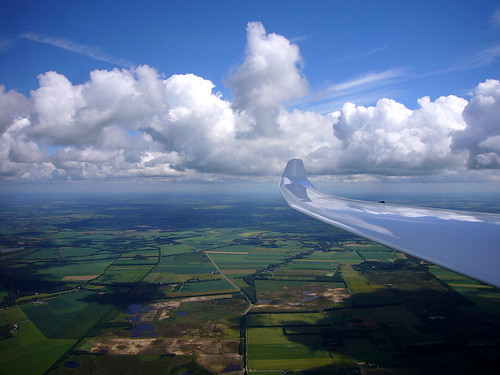
Good soaring today.  It looked a lot like this picture.
I showed up at Harris Hill later in the afternoon, a crisp, clear, 80 degree day that makes the summers in  the Finger Lakes so very, very pleasant.  I had, ahem, domestic duties to attend to but I kept glancing at the building cumulus clouds and feeling the day slip away from me.

Finally, around 3pm I made it out there and they were looking for someone to give a passenger ride so  I strapped in and took Amy from Big Flats up for a ride.  The conditions were GREAT and we stayed up almost at will, enjoying the scenery below.  At least 5 other gliders were near us -some high, some lower, some at our altitude.

After landing, there were no other passengers to take up but the conditions were so good, I decided to go alone.  I took off and Roy McMaster, our tow pilot, towed me right into a huge thermal.  I should have let off right then but was a little slow.  Fortunately, Roy did a 180 and towed me right back into the thermal.  I cut loose and started my climb upward.

4,000, 5,000, 6,000 feet and the thermals were solid with 4-6 knots showing on the variometer.  I looked out and saw a cloud street headed toward me, so I circled and waited.  Pretty soon, I was near cloud base and sharing the thermal with a hang glider.  As I topped out, I decided to jump across the blue gap over to the cloud street.  I pushed 70 knots through the blue and pretty soon I was across and under the next street over.  

The lift was good, the street was long, and I followed it down South of Elmira over Southport.  I was losing almost no altitude during the transit and used the time to figure out where the best lift was.  I turned back and traversed the street back to the North.

I spent the rest of the flight jumping from one cloud to another and trying to work on how to use them to move from one part of the sky to another.  After some time, I centered up a NICE 6 knot thermal underneath a cloud and rode it up to cloud base.  I began to get some rain on the canopy and checked to be sure it wasn't turning into a thunderstorm.  Off in the distance, I'd been watching a buildup that was moving towards me and decided that although the conditions were good, they were dying just a bit and I should probably get down and get the glider put away.

I landed around 5:30 with about an hour and a half on the clock.  The soaring was fantastic, and the skill building was great practice for cross country flying.  All in all, one of those soaring days that you dream about in the middle of winter and hope for on a summer weekend.  Awesome.

Thursday, June 21, 2012

Dreaming of cutting the strings...

I have...had...two goals for my flying this summer.  First, I wanted to get my tailwheel transition signoff  so I could learn how to fly as a tow pilot for our operation.  We're quite shy on tow pilots and...well...there's no reason I can't operate an aircraft with an engine.  I am, after all, certified for Aircraft Single Engine, Land (ASEL).  It's just been a while.  Plus, I sort of have a distrust of aircraft with engines, now that I've been flying aircraft without them for quite some time!

Anyhow, that goal is on hold after an incident that caused our club's Super Cub to depart the runway in gusty conditions (I was not part of this incident) and end up with quite a bit of damage.  It's out of commission for quite some time, likely the balance of our flying season at the very least.

The object of my desire - the Schempp-Hirth Discus
On to my second goal - get certified in the single seat Discus and learn to fly cross country.

They call it 'cutting the apron strings' and it means flying out of gliding distance from your home airport and often from any airport.  It is something that I've been trying to prepare for since I got my glider rating.

First step - fly with one of our cross country instructors in the Duo Discus, a two seat version of the Discus.  We are so fortunate to have world class pilots who will instruct you in the technique of cross country flying at Harris Hill and I will take advantage of that.  Once I learn the basic techniques, I'll get a checkout in the single seat Discus and the fly in tandem with another cross country pilot -me in the Discus, him in his glider.  I'll follow him to see how he does it and hopefully learn enough to begin learning on my own.

I also have the Condor glider simulator to work with.  It's a great tool for learning how to cross country soar.  I've ordered rudder pedals for my computer setup and will start giving it a workout.

I am, as everyone is when they start pushing out beyond the airport, excited and nervous.  I've done two things to try and prepare for this phase of my flying.  First, I've worked and worked at flying thermal circles at a steady airspeed and at least 45 degree bank angle.  It is critical to know how to quickly center and take advantage of a thermal when you encounter it.  I'm better than I was and I think I'm good enough to go out with an instructor and fly cross country.

Second, I've been learning about spotting lift conditions and cross country considerations.  I've read Helmut Reichman's excellent book, "Cross Country Soaring" on the advice of instructors and there is a LOT of information in there that can help you stay aloft.  I need to re-read it as I begin to fly cross country.

It's going to be a little while before I can get started, though.  Right now, my real-life workload just won't let up and has conspired to keep me from being flexible enough to pick a day to take off for training, a prime requirement for a good training start.  Hopefully, that will let up a bit soon but I've been thinking that for the past month and it hasn't happened.

It's killing me, too.  One of my soaring friends recently cut the strings and flew away on his first 150 mile triangle and sent back incredible pictures of him with a huge grin on his face as he circled at cloudbase.  We both started flying around the same time and our flight 'careers' have progressed at roughly the same pace.  I was surprised how much those pictures made me realize that I have to get REAL about making my transition to this new level of flying.  I'm not sure it is what I'll do ALL the time, but it is something that will make me a much better pilot, whether I fly locally or not.

Anyhow, I'm looking forward to the trip and I'll keep posting here about the journey.